Blog
Blog Supplier Hierarchy: The Ultimate Guide for 2026
Supplier hierarchy means two different things: a parent-child structure inside your vendor master, and a tier structure out in your supply chain. This guide covers both, plus what it takes to keep either one accurate.

Ask three people on a procurement team to define “supplier hierarchy” and you’ll likely get three different answers. One thinks in terms of subsidiaries rolling up to a parent company. Another thinks in tiers — who supplies your suppliers. A third just knows their SAP or Oracle instance has a hierarchy object they were told to configure, and they’re not entirely sure what it’s supposed to do.
That ambiguity is a data problem with real consequences. When nobody agrees on what the hierarchy is supposed to represent, nobody builds it correctly, and every report, negotiation, and risk assessment built on top of it inherits the error:
- Spend that should be consolidated under one negotiating umbrella stays scattered across a dozen subsidiary records.
- A supplier flagged as low-risk turns out to share an ultimate parent with three others already in distress.
- A Tier 2 diversity reporting requirement lands on a desk with no way to fulfill it, because nobody mapped past Tier 1 in the first place.
This guide covers both meanings of supplier hierarchy in full: the parent-child structure inside your vendor master, and the tier structure that extends out into your physical supply chain. It walks through the master data fields each one depends on, and the governance work that keeps a hierarchy accurate after the initial project ends.
What Is a Supplier Hierarchy?
A supplier hierarchy (also known as a corporate hierarchy) is a structured way of relating supplier records to each other — either by corporate ownership, where subsidiary and regional records roll up to a parent legal entity, or by supply chain position, where suppliers are ranked by how many steps separate them from your organization.
Those are genuinely two different things, and the confusion is understandable, because both get called “supplier hierarchy” without qualification. The ownership version describes relationships between records inside your systems: which vendor IDs actually refer to the same legal entity, and which entities answer to the same ultimate parent. The tier version describes distance in the physical supply chain: your direct suppliers, the suppliers who supply them, and so on upstream.
Both are legitimate, both solve different problems, and mature procurement organizations maintain both, usually poorly. Most teams give some informal attention to tiers, at least for their most critical categories, but not many maintain a governed, current parent-child hierarchy in their vendor master. This guide covers both, starting with the distinction, then the systems that hold each one, then the practices that keep them current and trustworthy.
The Two Types of Supplier Hierarchy
Parent-Child Corporate Hierarchies
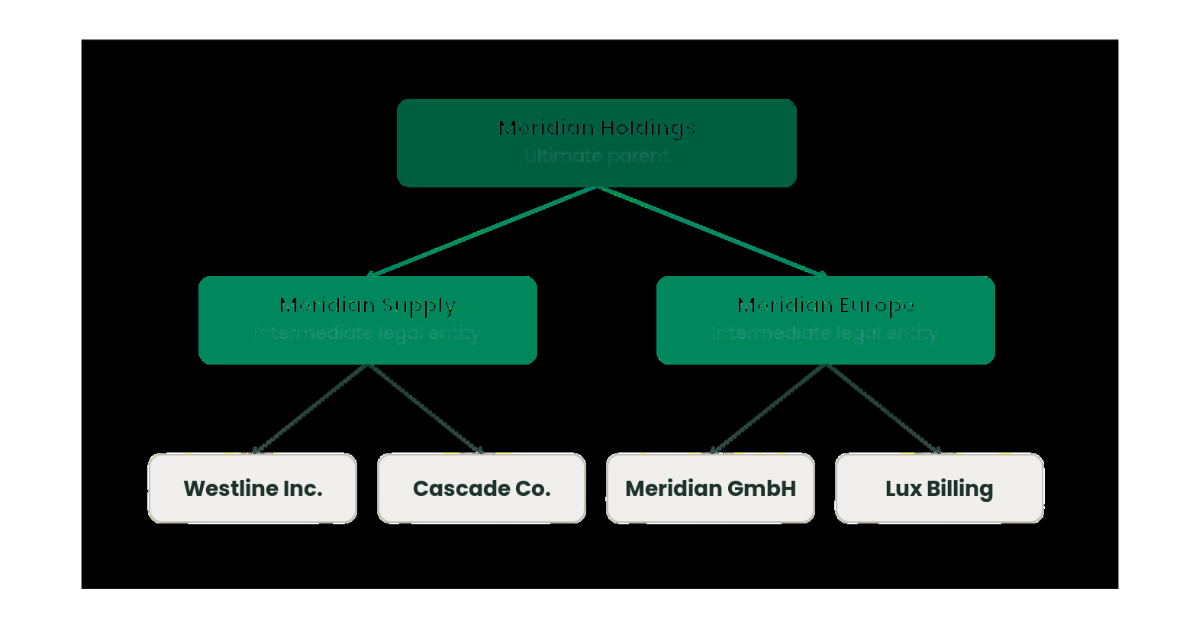
A parent-child hierarchy maps which supplier records refer to the same legal entity, and which legal entities roll up to the same ultimate parent. In a typical structure, an ultimate parent or global headquarters sits at the top, intermediate legal entities sit beneath it, and regional subsidiaries, branches, divisions, or distinct billing units sit as children underneath those.
The same supplier ends up fragmented across multiple records for reasons that have nothing to do with how the business actually operates: name variants entered differently at onboarding, separate regional legal entities that are genuinely distinct but commercially related, acquisitions still invoicing under their pre-acquisition brand name, and plain duplicate records created because nobody checked first.
Resolving that fragmentation pays off in terms procurement already cares about:
- Consolidated spend analysis reveals the true size of a relationship instead of a dozen partial views of it.
- Volume that qualifies for corporate-family pricing becomes visible and usable in negotiation, instead of sitting scattered across subsidiaries too small individually to matter.
- Risk reporting becomes unified rather than fragmented.
- Concentration that individual records hide — three “different” suppliers that are all subsidiaries of one parent — becomes visible before it becomes a problem.
Supply Chain Tiers: Tier 1, Tier 2, and Tier 3
Supplier tiers count the number of steps between your organization and a given supplier. Tier 1 suppliers are the ones you contract with directly, issue purchase orders to, and pay — and they’re the only tier fully visible in your own spend data. Tier 2 suppliers supply your Tier 1 suppliers. Tier 3 and beyond supply your Tier 2 suppliers, typically raw materials, components, and other upstream commodities.
The core problem with tiers is an inversion: visibility drops sharply with each step upstream, while the risk actually originating in the supply chain rises. The suppliers you can see least clearly are frequently where the most exposure sits, since labor practices, environmental impact, and geopolitical risk concentrate further upstream, not closer to home.
That inversion is why tiers have moved from a supply-chain-management curiosity onto procurement’s actual agenda. Supply chain due diligence and forced labor regulation increasingly extend accountability below Tier 1. Scope 3 emissions data, often the largest share of a company’s total footprint, lives at Tier 2 and beyond, not at Tier 1. And Tier 2 diversity spend reporting has become a contractual obligation in a growing number of enterprise, utility, and public-sector agreements, where prime suppliers are required to report subcontractor diversity spend on your behalf.
None of this means mapping every supplier to Tier 3 is the goal. It isn’t, and treating it as one is how tier-mapping projects stall. The practical approach is targeted: map Tier 2 where there’s regulatory exposure, an existing reporting commitment, or spend concentration significant enough to warrant the visibility.
Hierarchy Structure: The Anatomy of a Supplier Tree
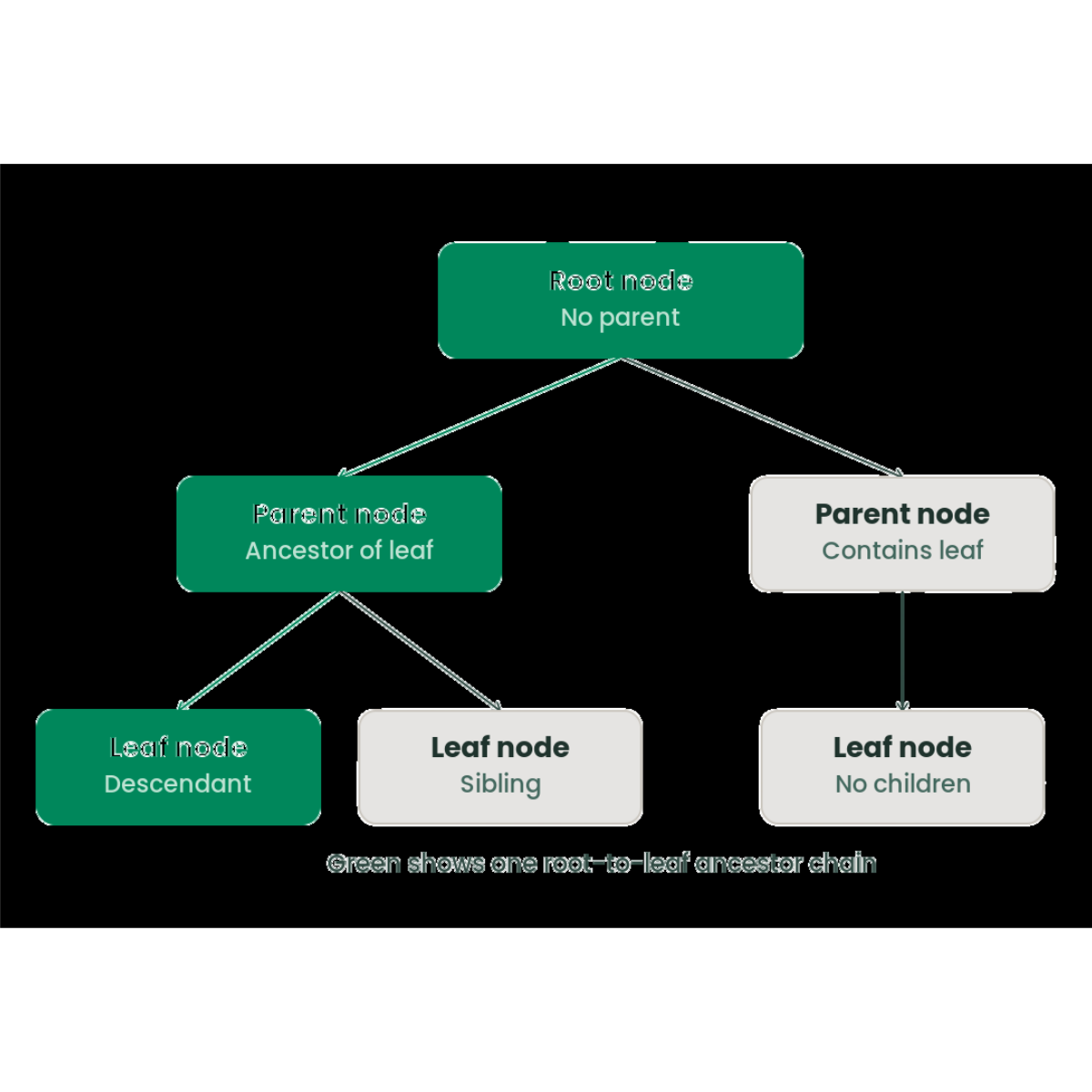
Whichever type of hierarchy you’re building, you’ll run into the same vocabulary in any ERP or master data documentation, because the terms are used consistently across systems. A root node sits at the top with no parent. Parent nodes contain other nodes beneath them. Leaf nodes sit at the bottom with no children of their own. Ancestor and descendant nodes describe position relative to any given node in the tree.
One constraint shapes most system design: in a conventional tree, every child node has exactly one parent, which means a supplier can sit in only one active hierarchy of a given type at a time. Hierarchies can have any number of levels beneath the root, but that single-parent rule is fixed.
This matters in practice because different functions often want different rollups of the same suppliers. Sales might want a hierarchy organized around commercial relationships; finance might want one organized around legal ownership for consolidated reporting; category management might want a third. A single tree can’t serve all three simultaneously — which forces a real decision between maintaining multiple hierarchy instances for different purposes, or standardizing on one governed structure and building views on top of it.
Why Supplier Hierarchy Management Matters
An unresolved supplier hierarchy isn’t easy to see at first. There’s no error message or a broken report, it just quietly returns a wrong answer to every question built on top of it. The cost only becomes visible when someone finally goes looking for the true relationship and finds it wasn’t there.
The consequences show up in a fairly consistent pattern across procurement organizations:
Spending concentration is understated. Fragmented records split one real relationship into several apparent ones, so category strategy and negotiation planning start from a baseline that’s already wrong.
Negotiating leverage goes unused. Volume that would qualify for corporate-family pricing sits scattered across subsidiaries instead of consolidated where it can be used.
Risk exposure is invisible. A supplier in financial distress looks small and manageable, until you discover several other “unrelated” suppliers are its sister companies, and the real exposure is much larger.
Contract value leaks. Spend flows to an affiliate at uncontracted rates while a negotiated parent-level agreement sits unapplied because the system never made the connection.
Duplicate payment risk rises. The same supplier under multiple vendor IDs invites double payment and inconsistent terms across what should be a single relationship.
Tier 2 and ESG reporting can’t be assembled. If the structure isn’t visible, it can’t be reported on, and it can’t be influenced.
Audits become expensive. Ownership structures and geographic exposure have to be reconstructed by hand, under deadline, instead of pulled from a system that already knows them.
Four moments tend to turn hierarchy management from a background annoyance into an urgent project:
- An ERP or source-to-pay migration with a data cleanup deadline attached
- An AI or analytics initiative that stalls because the underlying supplier data isn’t trustworthy enough to build on
- A compliance deadline requiring supplier data that can survive an audit.
Procurement teams that wait for one of these moments to arrive are, by definition, doing hierarchy cleanup with the least time to spare.
The Master Data Behind a Supplier Hierarchy
A hierarchy is only as good as the records it links together. That means the supplier master record has to carry the fields that actually make matching and rollup possible, not just the fields needed to cut a purchase order.
The fields that matter specifically for hierarchy include:
- Legal entity name as registered, not the trading name the supplier does business under
- Tax identification or company registration number
- Registered address and country of operation
- Unique supplier ID
- Parent and ultimate parent references
- Legal entity identifiers such as LEI or DUNS, where available
- Supplier status indicators such as active, blocked, or on hold
- Certification and license references
- Industry classification codes
Tax ID and registration number are the strongest matching keys available, by a wide margin. Hierarchies built primarily on name matching will not hold up over time, because names vary. Trading names, abbreviations, transliterations, and post-acquisition rebrands all break a name-based match that a registration number would have caught cleanly.
Industry Codes and Classification Fields
Industry codes — NAICS, SIC, or a regional equivalent — classify what a supplier actually does, which supports category rollup, benchmarking against peers, and diverse and small business reporting. They’re a supporting field for hierarchy work, not a matching key, but they matter for what you can do with the hierarchy once it’s built.
The practical failure mode is common: industry codes are frequently missing, self-reported, or inconsistent between systems, and a parent company and its subsidiaries are often coded differently even when the ownership hierarchy itself is entirely correct. That mismatch breaks category rollup in ways that look like a hierarchy problem, but are actually a classification problem sitting one layer beneath it.
How to Build a Supplier Hierarchy
This is the practical core of the work. It holds up whether you’re building a parent-child hierarchy, tier attributes, or both.
- Start with the suppliers that matter most. Resolve the corporate families of your top suppliers by spend first, manually if that’s what it takes. The largest concentration surprises are almost always hiding in your biggest relationships, not your smallest.
- Pick your matching keys before you start matching. Establish tax ID, registration number, and legal entity identifiers as your primary keys. Treat name and address as supporting signals that can corroborate a match, not as the basis for making one.
- Decide where the hierarchy will live. Name one governed supplier master that analytics, reporting, and every downstream system actually reads from. The common failure here is building a hierarchy in a spreadsheet or an isolated tool that no reporting layer ever consumes.
- Resolve duplicates before you map ownership. Mapping parent-child relationships on top of an unresolved, duplicate-riddled record set doesn’t fix the duplication, it encodes it permanently into the structure you’re building.
- Add tier attributes selectively. Map Tier 2 where there’s regulatory exposure, an existing reporting commitment, or real concentration risk. Store tier as its own attribute, separate from segmentation and criticality fields, since they answer different questions.
- Set the maintenance mechanism on day one. Define how new vendor records get validated against the hierarchy at intake, before the first record is even created, instead of during a cleanup exercise after the fact.
When to Create a New Hierarchy or a New Version
This decision recurs constantly once a hierarchy is live, and getting it wrong either way creates real cost.
A new hierarchy is warranted when there’s a genuinely new corporate structure to represent, a new business process with hierarchy requirements the existing structures can’t accommodate, or a supplier that has restructured so completely that editing the existing tree is slower and riskier than rebuilding it.
A new version is the better choice for smaller, more routine changes: adding, removing, or repositioning a single supplier, or a batch of changes substantial enough that they should go live together on a scheduled date rather than piecemeal as each one is discovered.
Manage Your Supplier Hierarchy with Atlas
Everything above describes work that’s conceptually straightforward and operationally hard: matching keys are known, the master data fields are well understood, and the underlying mechanics are documented. Yet most procurement teams still don’t have a clean, current hierarchy, because doing this by hand at enterprise scale, then keeping it accurate as vendor records change every day, isn’t realistic without dedicated tooling.
Atlas, Supplier.io’s vendor master data management solution, is built specifically for this problem, and it maps directly to the three failure points this guide has walked through:
Entity resolution. Atlas resolves fragmented and duplicated vendor records to verified legal entities at roughly an 85% automated match rate, matched against a database of 239M+ legal entities across 145 countries and anchored in country-level registries. Every match is traceable to the legal entity filing behind it, rather than surfaced as an unexplained confidence score you have to take on faith.
Corporate hierarchy mapping. Atlas maps parent-child and ultimate ownership relationships across your vendor master, surfacing hidden affiliations and concentration risk that would otherwise take a manual, recurring research exercise to uncover — the exact exercise most enterprise procurement teams are currently doing by hand, or not doing at all.
Continuous maintenance. New vendors are validated against the legal entity database at intake, so the hierarchy doesn’t quietly decay the moment the initial cleanup project closes out. Each resolved record is also enriched with 350+ attributes, keeping the hierarchy connected to the data that makes it useful for reporting, not just structurally accurate.
Supplier.io has been building supplier intelligence for more than 20 years and is trusted by a majority of the Fortune 100, with a supplier database spanning 20M+ profiles — more than half of them outside the US — verified against 450+ sources. That scale is what makes an 85% automated match rate meaningful rather than theoretical: the database has to be large enough, and current enough, for a match to actually mean something.
If your team is heading into an ERP migration, reconciling two vendor masters after a merger, or trying to answer a Tier 2 or Scope 3 reporting requirement you currently can’t fulfill, the hierarchy work described in this guide is the prerequisite, not a nice-to-have layered on top of it.
Book a demo to see how Atlas resolves your vendor master to verified legal entities and keeps it that way.