Blog
Blog AI and Supplier Data Quality Management: Use Cases and Benefits
Your AI tools in procurement are only as good as the supplier data underneath them. Here’s what it takes to get that data right.

Your procurement team just invested in an AI-powered spend analytics tool, your risk team added an AI supplier monitoring platform, and your compliance team is using AI to screen suppliers against sanctions lists. Six months in, none of them are performing the way the vendor promised.
The technology probably isn’t the problem, but the supplier data underneath it is. AI in procurement is only as reliable as the data it runs on, and most enterprise vendor masters are full of duplicates, stale records, missing attributes, and unresolved ownership structures. When the data is wrong, the AI output is wrong, no matter how advanced the model is. Research from Gartner finds that 85% of AI models fail because of poor data quality or little to no relevant data.1 In fact, 59% of procurement leaders say data quality is the #1 barrier to broader AI adoption.2
This blog covers the supplier data quality practices that AI depends on to work well, why each one matters, and what breaks when any of them are missing.
What Is Supplier Data Quality Management — and What Does It Have to Do with AI?
Supplier data quality management is the ongoing work of making sure your supplier records are verified complete, current, and consistent across your systems. It covers everything from removing duplicate vendor records and verifying legal identities, to tracking certification status, mapping ownership structures, and making sure new suppliers are properly validated before they enter your systems.
The connection to AI is direct. Every AI tool your procurement or finance team uses, whether it be spend analytics, risk monitoring, compliance screening, sourcing optimization, reads from your supplier data. If that data is fragmented, duplicated, or out of date, the AI produces fragmented, duplicated, and out-of-date outputs. Garbage in, garbage out is not a new principle, but it has higher stakes when AI is making recommendations at scale.
More than half of procurement leaders (51%) say their biggest AI concern is data hallucinations — AI making poor decisions because of inaccurate or incomplete supplier data.¹
Getting supplier data quality right is a continuous discipline. The good news is that when it’s done well, AI tools across your procurement stack work the way they were designed to, and the ROI of those investments starts to show up in the numbers.
Why Most Vendor Masters Aren’t AI-Ready
Enterprise vendor masters tend to accumulate problems over years of system migrations, acquisitions, and manual data entry. The most common issues are:
- Duplicate records: The same supplier exists under multiple names and IDs across ERP, procurement, and finance systems
- Missing attributes: Records lack the enriched data, such as industry codes, certifications, ownership, ESG status that AI tools need to function
- Stale data: Certifications have lapsed, ownership has changed, and financial health has shifted without any of it being captured
- Fragmented identities: No single verified record ties together everything known about a given supplier across systems
- Hidden concentration risk: What looks like a diversified supplier base is actually several vendors owned by the same parent company
Each of these problems limit what AI can do. Taken together, they explain why AI initiatives in procurement so often underperform expectations.
Supplier Data Quality Practices That Make AI Work
These seven practices are the core of supplier data quality management in a large enterprise. Each one matters on its own. Together, they’re what makes AI work.
1. Vendor Master Deduplication
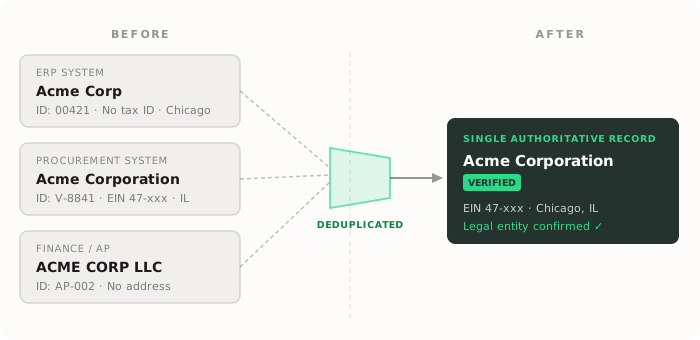
Duplicate vendor records are one of the most common and most damaging supplier data problems. The same supplier — entered as “Acme Corp,” “Acme Corporation,” and “ACME CORP LLC” across different systems — creates three separate records that no system can connect. Spend is split across all three, risk is assessed separately, and performance history is fragmented.
Deduplication identifies records that refer to the same real-world supplier and consolidates them into a single, authoritative entry. This is harder than it sounds when records have inconsistent names, addresses, tax IDs, and formats, which is almost always the case in a large enterprise.
What it unlocks for AI: AI spend analytics, risk models, and supplier scoring tools all need to aggregate data by supplier. When duplicates exist, those aggregations are wrong. Deduplication is the first step toward AI outputs you can trust.
2. Legal Entity Resolution
Deduplication finds duplicate records. Legal entity resolution goes further by connecting each supplier record to a real, registered legal entity. That connection is anchored in official government registries, country by country.
This is how you confirm that the “Acme Corp” in your system is a real company, legally registered, and not a name variation, a shell, or a data entry mistake.
Why does it matter if a supplier is a real registered company? Because registration means accountability. A legally registered entity has a verifiable address, ownership structure, and government-assigned identifier. If something goes wrong — a failed delivery, a contract dispute, a fraud investigation — you have a real legal party to go after. If your supplier isn’t registered, or if your record points to the wrong entity, you may have no legal recourse at all. You could be paying a company that doesn’t exist, or contracting with a subsidiary when you think you’re working with the parent.
Without verified legal entity data, you can’t reliably screen suppliers against sanctions lists, confirm ownership, or know that the entity you’re paying is the one you contracted with.
What it unlocks for AI: AI compliance screening, payments fraud detection, and sanctions monitoring all depend on matching your supplier records to verified legal identities. A model that can’t confirm who a supplier actually is can’t reliably flag risk or find matches against watchlists.
3. Data Enrichment
Most vendor master records contain only the minimum needed to process a payment: a name, an address, a bank account. They’re missing the attributes that procurement, compliance, and risk teams actually need — industry classification, employee count, revenue range, ownership structure, diversity certifications, ESG status, and compliance history.
Data enrichment fills in those gaps by pulling verified information from authoritative external sources and adding it to each resolved supplier record. The result is a record that supports real decisions, not just payment processing.
What it unlocks for AI: AI sourcing tools, risk platforms, and spend analytics engines rely on supplier attributes to generate recommendations and scores. A record with five attributes produces a much weaker output than a record with 350. Enrichment is what gives AI enough signal to work with.
4. Corporate Hierarchy Mapping
A supplier’s legal name tells you who they are. Their corporate hierarchy tells you who owns them and who else you might be exposed to through that relationship. Parent companies, subsidiaries, joint ventures, and affiliated entities all matter when you’re assessing concentration risk, negotiating spend, or screening for sanctions.
Corporate hierarchy mapping connects each supplier to the full ownership structure above and below them. A supply base that looks diversified across 10 vendor records might actually concentrate significant spend and risk in two parent companies. That exposure is invisible without hierarchy data.
What it unlocks for AI: AI risk monitoring and spend analytics tools can only assess true exposure when they understand ownership relationships. A risk model that treats subsidiaries of the same parent as independent suppliers will consistently underestimate concentration risk.
5. Certification and Compliance Monitoring
ISO registrations, diversity certifications, and regulatory approvals all have expiration dates. When they lapse and no one catches it, your approved supplier list is wrong. Any AI compliance tool running on that list will give you false confidence by claiming suppliers are compliant when they’re not.
Certification and compliance monitoring tracks each supplier’s credentials continuously. It checks against official certification bodies and registries, and alerts your team when something expires or can’t be verified. Your compliance data stays current, not just accurate as of the last manual review.
What it unlocks for AI: AI compliance screening, supplier qualification, and audit tools are only as good as the data they read. When certification status is up to date, AI can screen thousands of suppliers quickly and with confidence. When it’s not, AI multiplies the problem.
6. New Supplier Intake Validation
The easiest way to maintain supplier data quality is to prevent bad data from entering your systems in the first place. New supplier intake validation checks each new vendor submission against legal entity registries, certification databases, sanctions lists, and internal policy requirements before the record is approved and created.
This stops inaccurate suppliers from entering your vendor master and means that every record created is clean and enriched from day one. It also compresses qualification timelines, since automated validation replaces weeks of manual back-and-forth.
What it unlocks for AI: AI sourcing, risk, and compliance tools work from your approved supplier list. When that list is validated at intake, AI has a reliable starting point. When intake is manual and inconsistent, bad records accumulate and AI recommendations degrade over time.
7. Continuous Data Maintenance
Supplier data changes constantly, ownership transfers, certifications are renewed or lapse, addresses change, financial health shifts, key contacts leave, and a vendor master that was clean six months ago may already be significantly out of date.
Continuous data maintenance monitors your supplier records against authoritative external sources and captures changes as they happen, not at the next scheduled cleanse. When something changes, the record is updated.
What it unlocks for AI: AI outputs reflect the data in your systems at the moment the model runs. If that data is stale, the output is stale. Continuous maintenance is what ensures AI risk scores, spend analyses, and compliance checks are based on what is actually true about your suppliers today.
What Good Supplier Data Quality Unlocks
When these seven practices are working together, the benefits show up across the business, not just in cleaner spreadsheets.
AI That Actually Performs
Every AI tool in your procurement stack works better when the supplier data underneath it is accurate, complete, and current. Spend analytics finds real savings opportunities. Risk monitoring surfaces real risks. Compliance screening catches real issues. The technology investment starts delivering the ROI it was purchased for.
Lower Compliance and Audit Risk
Accurate, continuously maintained supplier records mean your compliance reporting reflects reality. Certifications are current. Ownership structures are visible. Sanctions screening runs against verified legal entities, not guesses. When an audit comes, your team can show the work rather than scramble to reconstruct it.
Faster Supplier Onboarding
Validating new suppliers at intake, automatically and against verified sources, compresses qualification timelines from weeks to days. The record that gets created is also clean from the start, which means it doesn’t require correction later and can immediately support AI-powered workflows.
Accurate Spend and Risk Visibility
With duplicate records resolved and ownership structures mapped, spend analytics can show true supplier spend by legal entity and by ownership group. Risk tools can assess real concentration. Both give leadership a reliable picture of where the business is exposed — which is the starting point for better negotiating, better diversification, and better contingency planning.
A Supply Chain That Can Use AI Confidently
Teams that trust their supplier data make better decisions faster. They can act on AI recommendations without second-guessing whether the underlying data is right. That confidence is the compounding advantage of getting supplier data quality right — it makes every tool, every model, and every team more effective over time. As Ardent Partners put it: “Clean, connected, accessible data is the prerequisite for AI performance, not the follow-on project.”¹
Atlas: The Supplier Data Foundation That Makes AI Work
Most AI initiatives in procurement underperform for the same reason: the supplier data underneath them was never prepared to support AI. It’s fragmented, duplicated, and stale. Supplier.io fixes that at the root.
Supplier.io is a supplier intelligence platform that resolves, enriches, and continuously maintains the supplier data that procurement, finance, and compliance teams build their decisions on. It’s not a source-to-pay platform, a quality management system, or a risk tool. It’s the supplier data and intelligence layer that makes those systems perform as designed — because none of them can outperform the data they run on.
Atlas (vendor master data management) is the core of that foundation. It resolves duplicated and fragmented vendor records to verified legal entities at roughly an 85% automated match rate, against a proprietary dataset of 239M+ legal entities across 145 countries and 308 jurisdictions, anchored in country-level registries. Every match is traceable to a legal entity filing with confidence scores at the attribute level — so every decision survives an audit. Atlas maps parent-child and ultimate ownership relationships, enriches each resolved record with 350+ attributes, and validates new vendors at intake for continuous maintenance.
Supplier.io is trusted by a majority of the Fortune 100 and is the only platform combining legal entity infrastructure with 20 years of proprietary supplier diversity, sustainability, and firmographic data. It is built to resolve the hardest suppliers to identify — the small, local, and diverse businesses that rarely appear cleanly in commercial databases.
“We were able to do a really quick ROI on just the proof-of-concept records and it’s going to save us almost $1 million worth of maintenance a year.”
— Stefanie Fink, Head of Global Data & Digital Procurement at Kraft Heinz
If your AI tools in procurement aren’t delivering, the supplier data underneath them is the most likely reason. Supplier.io gives you the clean, resolved, continuously maintained foundation that makes AI work the way it’s supposed to.
Your Supplier Data Is Either Ready for AI or It's Not
Atlas gives you the clean, resolved, continuously maintained foundation that makes AI work the way it’s supposed to.
Book a demo1 Jameel Francis, “Why 85% Of Your AI Models May Fail,” Forbes Technology Council, November 15, 2024.
² Ardent Partners, The Path to AI-First Procurement, June 2026.