Blog
AI Adoption in Procurement is Accelerating, but Confidence in Supplier Data Isn’t
More than half of supplier programs now use AI, but fewer than half of leaders trust the data underneath it. Here’s what the 2026 State of Supplier Diversity Report found, why AI makes bad supplier data more costly, and the sequence that fixes it.

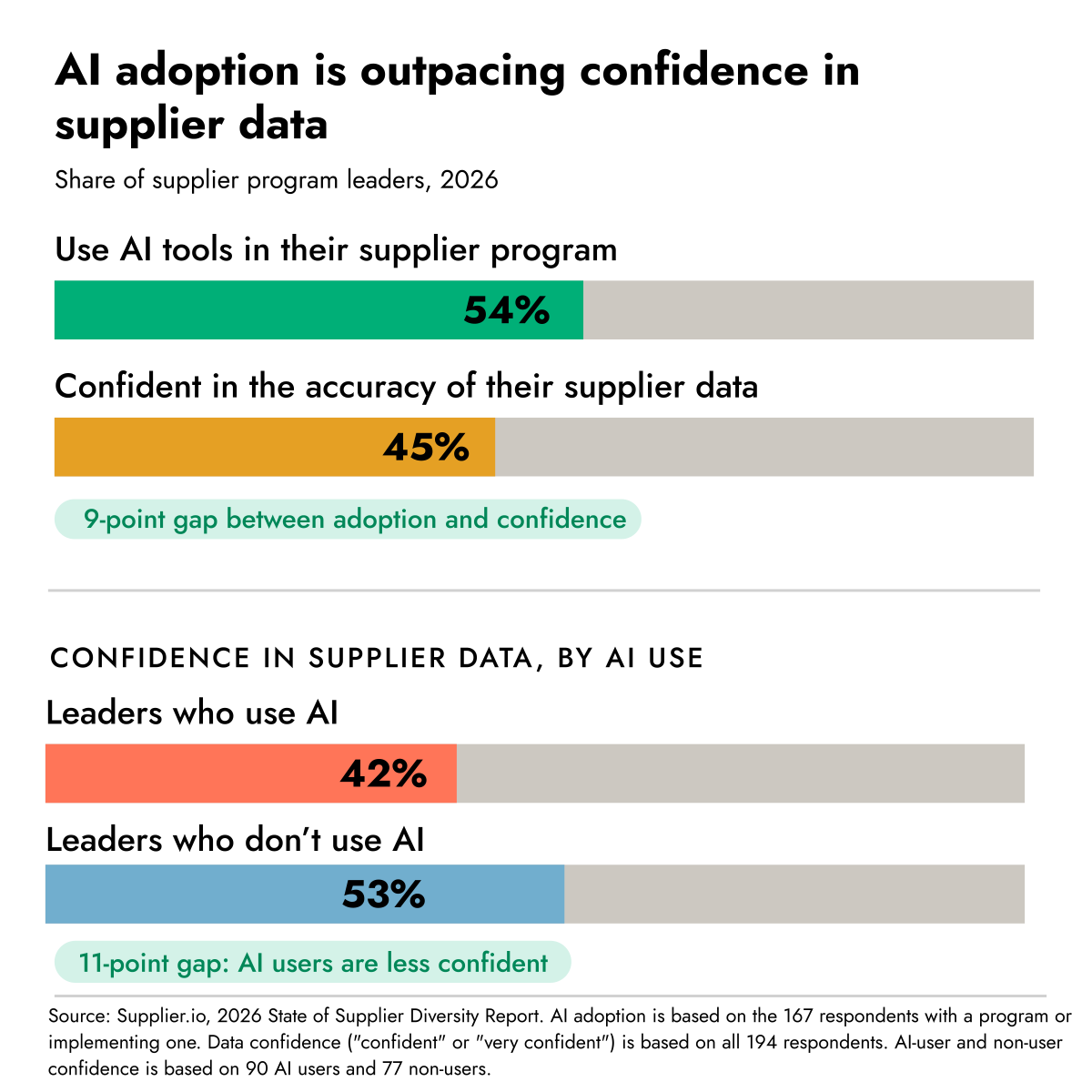
More than half of supplier programs now use AI, but fewer than half of the leaders running them trust the data underneath it. In the 2026 State of Supplier Diversity Report, 54% of leaders said they use AI tools in their supplier program, yet only 45% are confident in the accuracy of their supplier data. Among AI users, that confidence drops to 42%.
That gap is riskier than it looks. Procurement data quality for AI is the deciding factor: AI applied to incomplete or duplicated supplier records scales the errors instead of fixing them. The sequence that works is one trusted record per supplier, verified at a source you can defend, refreshed continuously, and only then a wider role for AI. Below, we cover why AI makes bad supplier data more costly and what it takes to make supplier data trustworthy.
What did the 2026 State of Supplier Diversity Report find about AI and data?
The numbers come from Supplier.io’s ninth annual survey of procurement, sourcing, and supplier diversity leaders. It is the first edition to ask about AI, and the baseline is high. Data quality has sat near the top of the challenge list in every edition of this series, and this year’s results show AI adoption running well ahead of it. Independent 2026 research points the same way. ProcureCon’s CPO report found that only 11% of respondents are fully ready to leverage AI in procurement, and the Economist Enterprise study found that 60% of executives now rank digital transformation as procurement’s top priority, up from 38% a year earlier.
The survey drew 194 leaders, most at large organizations. Here is how AI adoption and data confidence compare:
| Finding | Result |
| Leaders using AI tools in their supplier program | 54% |
| Leaders confident or very confident in supplier data accuracy | 45% |
| Leaders who are not at all confident | 9% |
| Leaders naming incomplete or inaccurate data as a top-two data challenge | 57% |
| Leaders naming data quality and accuracy a top-three program challenge | 37% |
| AI users confident in their supplier data | 42% |
| Non-users confident in their supplier data | 53% |
Among AI users, 60% apply it to supplier discovery and sourcing recommendations, 42% to data enrichment and cleansing, and 37% to spend categorization and reporting. All three depend directly on the quality of the supplier record underneath.
The last two rows deserve a second look. Survey data showed that leaders who use AI are less confident in their data than leaders who don’t. That doesn’t prove AI erodes confidence, but could indicate that AI exposes gaps that manual workarounds used to hide. Either way, the people closest to AI are the least sure of what it’s running on.
Is the same gap showing up in other 2026 research?
Yes. Independent studies from this year describe the same pattern: ambition is rising fast, readiness is lagging, and data is the sticking point.
- Priority is surging. In the Economist Enterprise study of 2,648 C-suite executives, 60% named digital transformation procurement’s top strategic priority for the next 12 to 18 months, up from 38% in 2025, and 56% identified AI as the primary driver. More than half plan to implement or evaluate agentic AI in that window.
- Readiness is not keeping up. ProcureCon’s 2026 CPO report found that only 11% of respondents are “fully ready” to leverage AI and machine learning in procurement. Among the rest, 54% cite insufficient data quality and integration across procurement systems as a top barrier. The report’s own advice: address data quality, integration, and governance before scaling AI investments.
- Results are not yet showing. SAP notes that many executives report AI has yet to meaningfully improve the quality of procurement decisions despite growing investment, and that fragmented data remains one of the most significant barriers.
- Companies that succeed fix the foundation first. A Harvard Business Review article found that the companies seeing results are strengthening their data foundation and building governance into deployments from the start, rather than layering new tools onto existing workflows.
Read alongside the 2026 State of Supplier Diversity report findings, the pattern holds across surveys, roles, and publishers. Enthusiasm for AI is not the constraint, but trusted data is.
Why does AI make bad supplier data more costly?
Without AI, bad supplier data is slow and annoying, but its errors tend to be visible. An analyst notices that a supplier total looks wrong and goes digging. With AI, the same errors arrive in clean, confident output. A recommendation engine doesn’t flag that two records are the same company or that a certification expired last year. It ranks them anyway.
Three things make the combination worse than either problem alone:
- Errors scale. A duplicate record that misleads one analyst can mislead every model, report, and agent that reads from the same source.
- Trust gets misplaced. Fluent output feels more reliable than a spreadsheet, so fewer people question it.
- Problems surface late. Teams often discover the data issue only after an AI project stalls or a number fails an audit.
Gordon Donovan, VP of Research for Procurement and External Workforce at SAP, describes the stakes the same way: every new AI-enabled action “creates another vulnerability where poor data or weak oversight affects a business decision.” That vulnerability grows as AI moves from recommending to acting. More than half of executives in the Economist Enterprise study plan to implement or evaluate agentic AI within 12 to 18 months, and agents execute workflows, from guided buying to purchase order creation. A wrong supplier record behind a recommendation is an error someone can catch. Behind an agent, it becomes a transaction. Donovan put it plainly: “AI won’t do the thinking for procurement. But it has a way of exposing where thinking has, or hasn’t, already been done.”
There’s also a loop worth naming. Forty-two percent of AI users apply AI to data enrichment and cleansing, which means many teams are asking AI to fix the data it also depends on. Without an authoritative reference to match against, that’s guesswork at speed.
What does trusted data actually require for procurement AI?
“Clean” is a low bar. Trusted supplier data has to hold up when a CPO, CFO, or auditor asks how you know. The report’s findings point to four requirements.
One identity per supplier. The same supplier often appears under many names across systems. Forty-six percent of leaders say their data comes from too many disconnected sources, and 39% have no centralized system to manage it. Trusted data resolves every record to a single verified legal entity, the officially registered business behind a supplier name, as recorded in a government registry.
Hierarchy and context. A supplier record is only useful if you know who owns it. Parent and subsidiary relationships change through M&A, and spend with one corporate family is easy to miss when each entity sits in a separate record.
Verification you can defend. Thirty-eight percent of leaders find certifications difficult to verify, and 10% do not verify at all. The problem is structural: minority-owned certifications alone come from more than 350 agencies, and among veteran-owned businesses, self-certified suppliers account for 1.7% of certifications but 9.7% of spend. Trusted data traces back to a source, not just a score.
Freshness. Forty-nine percent say suppliers do not keep their information up to date, and 43% lack the staff to maintain it. Only 34% of organizations refresh supplier data quarterly, and 26% do so continuously. A one-time cleanse starts decaying the day it finishes. As a Manager of Global Digital and Data at a large food manufacturer recently put it: “Maintenance is key. We do this big cleanse for what? We have to also put a strategy in place to maintain the cleanse so that we do not fall back into our negative ways of the past.”
What’s the sequence that turns AI from a liability into something useful?
The report’s guidance for 2026 is to treat AI as a data quality question first. In practice, that means working in this order:
- Establish one trusted record per supplier. Match vendor master records to verified legal entities, surface and flag duplicates, and link each record to its corporate parent. Do this before any model reads the data.
- Verify at a source you can defend. Every attribute, from legal identity to certification status, should trace back to a registry or issuing agency. If you can’t show where a value came from, you can’t defend the output built on it. When information is incomplete, the system should surface that limitation or route the matter to a person rather than present an assumption as fact. Attribute-level confidence scores make that possible.
- Set a refresh cadence and automate maintenance. Decide how often records are reviewed, who owns them, and how new suppliers are validated at intake so the vendor master doesn’t drift back.
- Then widen AI’s role, one use case at a time. Start where the data is strongest and the output is easy to audit. Supplier discovery is where most teams already are. Expand to risk scoring, spend categorization, and agents as confidence in the foundation grows.
How does Atlas by Supplier.io fit in?
Atlas by Supplier.io is the enterprise supplier data foundation built for steps one through three. It matches vendor master records against a proprietary legal entity dataset across 145 countries, anchored in country-level registries. Each record can be enriched with over 350 attributes, including corporate hierarchy, ESG status, diversity certifications, and compliance flags, all tied to the same legal entity.
Two design choices matter for AI readiness. First, every match is traceable to a legal entity filing, and confidence scores operate at the attribute level, so teams can see which parts of a record are certain and which are inferred. Second, Atlas maintains the data continuously, so the foundation doesn’t decay after a one-off project. Kraft Heinz saves nearly $1 million annually in supplier data maintenance costs using Atlas as its foundational platform.
Ready to find out how much of your supplier data AI can trust?
See how many of your vendor master records resolve to verified legal entities, and what that means for your AI roadmap.
Book a demoFrequently asked questions
AI models and agents learn from and act on the records they’re given. If those records contain duplicates, outdated certifications, or unresolved corporate hierarchies, the output reflects those flaws, often with high apparent confidence. Trusted supplier data gives AI an accurate, auditable starting point.
According to the 2026 State of Supplier Diversity Report, 54% of leaders say they use AI tools to support supplier discovery, sourcing, or data management. The most common uses are supplier discovery and sourcing recommendations (60% of AI users), data enrichment and cleansing (42%), and spend categorization and reporting (37%).
Only 45% describe themselves as confident or very confident in the accuracy of their supplier data. Forty-seven percent are somewhat confident and 9% are not at all confident. Among leaders who use AI, 42% are confident, compared with 53% of leaders who do not.
Few say they are. ProcureCon’s 2026 CPO report found that only 11% of respondents are fully ready to leverage AI in procurement, and 54% of the rest cite insufficient data quality and integration as a top barrier. Supplier.io’s 2026 survey found a similar gap: 54% of leaders already use AI, but only 45% are confident in their supplier data.
Trusted supplier data is data you can defend when asked how you know. It resolves each supplier to one verified legal entity, links it to its corporate hierarchy, traces every attribute to a verifiable source, and is refreshed on a regular cadence. A confidence score alone is not enough without the evidence behind it.
Establish one trusted record per supplier, verify certifications and identity through a source you can defend, and set a refresh cadence. The 2026 report recommends treating AI as a data quality question first, because AI applied to incomplete data only scales the problem.
AI can help with matching and enrichment, and 42% of AI users already apply it that way. But it needs an authoritative reference to match against, such as legal entity registries, and a way to explain each decision. Without both, AI-driven cleansing risks introducing new errors that are hard to audit.
Agentic AI executes workflows, such as guided buying or purchase order creation, instead of only recommending actions. In the Economist Enterprise study, more than half of executives plan to implement or evaluate it within 12 to 18 months. Because agents act, a wrong or duplicated supplier record becomes a transaction, not just a bad insight.
The 2026 report urges programs to set a deliberate cadence, and only 34% of organizations currently refresh quarterly while 26% refresh continuously. Because suppliers change ownership, certifications, and details constantly, continuous maintenance protects the foundation better than periodic one-time cleanses.
Explainable match logic shows which specific attributes and rules led to a match, traced back to a legal entity filing, rather than returning a score to take on faith. It lets analysts, CFOs, and auditors verify how two records were linked, which makes downstream spend analytics and AI outputs defensible.