Blog
Blog The Cost of Bad Supplier Data: What 3 Experts Want Procurement to Know
Procurement leaders rated their own supplier data trust at 6 out of 10. Experts from Supplier.io and The Hackett Group explain why AI just raised the stakes, and what fixing the foundation is worth.

Procurement teams have spent years, and in many cases millions of dollars, trying to fix supplier data. Cleansing projects get funded, records get scrubbed, and for a while the reports look right. Then the duplicates creep back, spend fragments across systems again, and the same broken foundation resurfaces just in time for the next big initiative to trip over it.
That frustration anchored a recent conversation between Stephany Lapierre, Chief Strategy Officer at Supplier.io, and Chris Sawchuk and Abby Ommen of The Hackett Group. Their argument, backed by live poll data, new research, and a few uncomfortable real-world examples: the era of working around bad supplier data is ending, and AI is the reason.
Here are the takeaways worth bringing back to your team. Prefer to watch? The full recording is available on demand.
Procurement Leaders Rated Their Own Supplier Data And It Averaged a 6
The session opened with a live poll: on a scale of 0 to 10, how much do you trust the quality of your supplier data today?
Among the procurement professionals who answered, the average score was about 6 out of 10. Four in ten rated their data a 5 or lower. And out of 43 respondents, exactly one gave their supplier data a perfect 10.
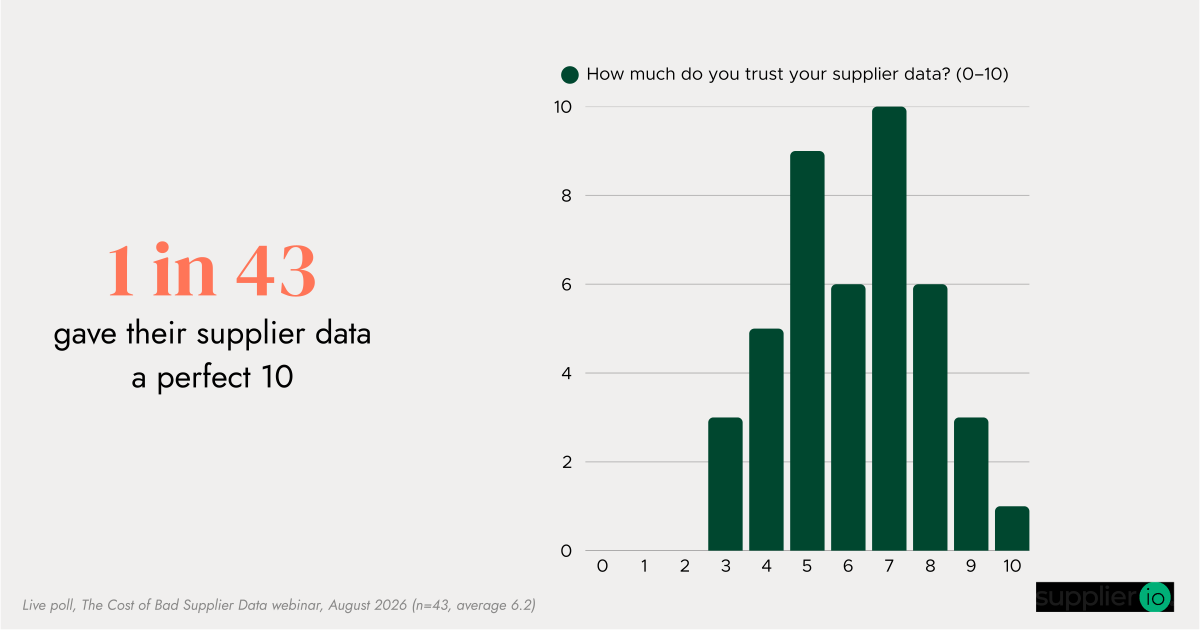
Lapierre pointed out what that middle-heavy distribution really means. Teams trust data they have manually prepared for a specific purpose, like a spend report or a system migration. The harder question is whether they trust it at scale: “Do you trust the information that is producing those insights enough to make some really important decisions?”
Why The Grace Period Is Over
For decades, organizations could live with imperfect supplier data because there was always time to patch it. Lapierre described the familiar pattern: clean the file before the spend analysis, scrub the records before the ERP migration, prepare the data before reporting to a regulator. The problem never went away, but people and services could compensate for it, one activity at a time.
AI removes that window. “With AI, you don’t have that period where you can manipulate the data,” Lapierre explained. “AI needs the context and needs data that is trusted in order to produce the output that we need it to do.”
“We hear this from procurement: we’re going to use LLMs to fix our data quality. I guarantee you, that is not possible. Not today.”
The Stephanie Problem: Why Cleanup Projects Keep Failing
To explain why supplier records resist one-time fixes, Lapierre offered an example from her own life. She works with two other Stephanies: one spelled with an IE and a Stefanie with an F. Her own last name might be entered as Lapierre, LaPierre, LAP, or even SL Corporation by someone in a rush.
So when a CFO asks a seemingly basic question, “How much are we spending with Stephanie?”, the answer depends entirely on whether those records have been reconciled. Ask an AI system the same question and it will produce an answer either way. “It may have bulked all the Stephanies together, or taken a portion of a Stephanie and completely ignored all the Lapierres,” she said. The answer arrives quickly and confidently. It may also be wrong.
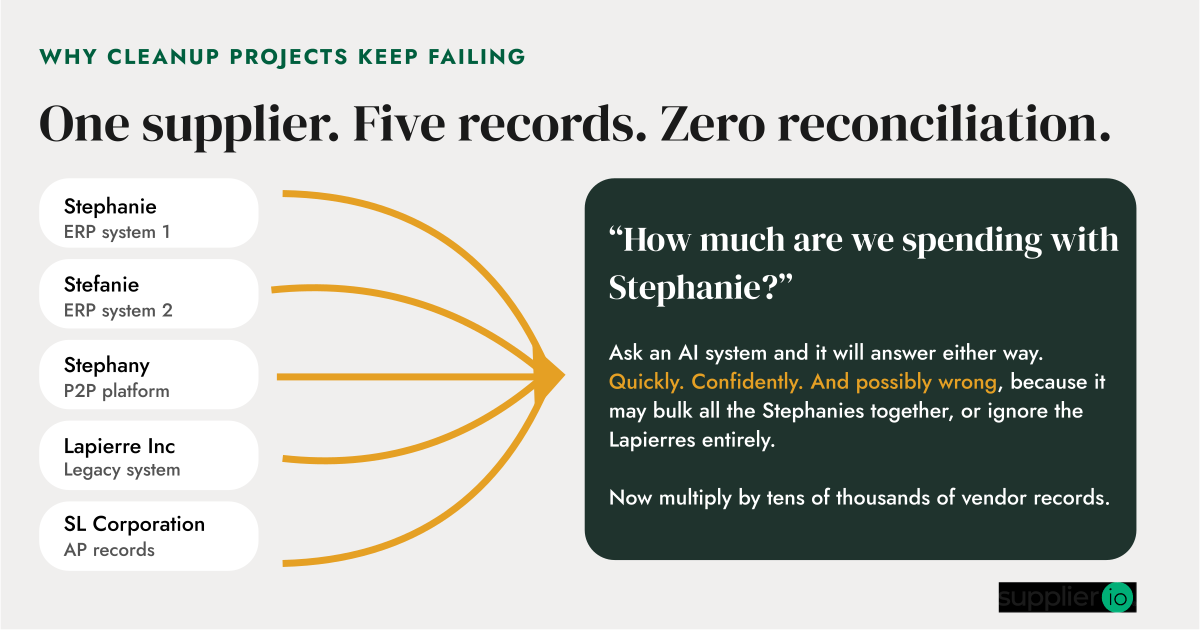
Now multiply that across tens of thousands of vendor records, multiple ERPs, and a dozen digital tools purchased over the past five years. Even highly experienced data teams that build their own matching logic struggle to keep up, because there are a million edge cases and the data changes constantly.
AI Doesn’t Forgive Bad Data, It Scales It
Two examples from the recent MIT CDOIQ Symposium that Lapierre attended made the stakes concrete:
- In a controlled experiment, researchers deliberately introduced duplicate records into an AI decision system. One in seven records received the wrong priority decision, a 14 percent decision-quality tax from duplication alone.
- At one organization, an AI agent processing invoices read only the PDF attachments and missed a “please disregard” email that followed. The result: $700,000 in double-paid invoices, plus the cost and disruption of unwinding the mistake.
Ommen added a finding from Hackett’s research that captures the market’s confusion: 65 percent of procurement leaders expect agentic AI to produce better data. “Which is backwards thinking,” she said. “Agentic AI does not create better data. Agentic AI relies on better data.”
Her metaphor captures why the problem hides for so long: “If your plumbing is junk, your sink is going to be constantly clogged. And you may not even realize it until that clog is incredibly hard to remove.”
Technology Is Ready, Governance Isn’t
Hackett’s research on AI solution providers found strong support at the technology layer but far weaker support at the governance layer, the layer supplier data quality depends on. As Ommen put it: “Everybody can make an agent nowadays. We could all spend 10 minutes on a YouTube video and figure out how to make an agent. We can think that agent’s working. It’s probably not.”
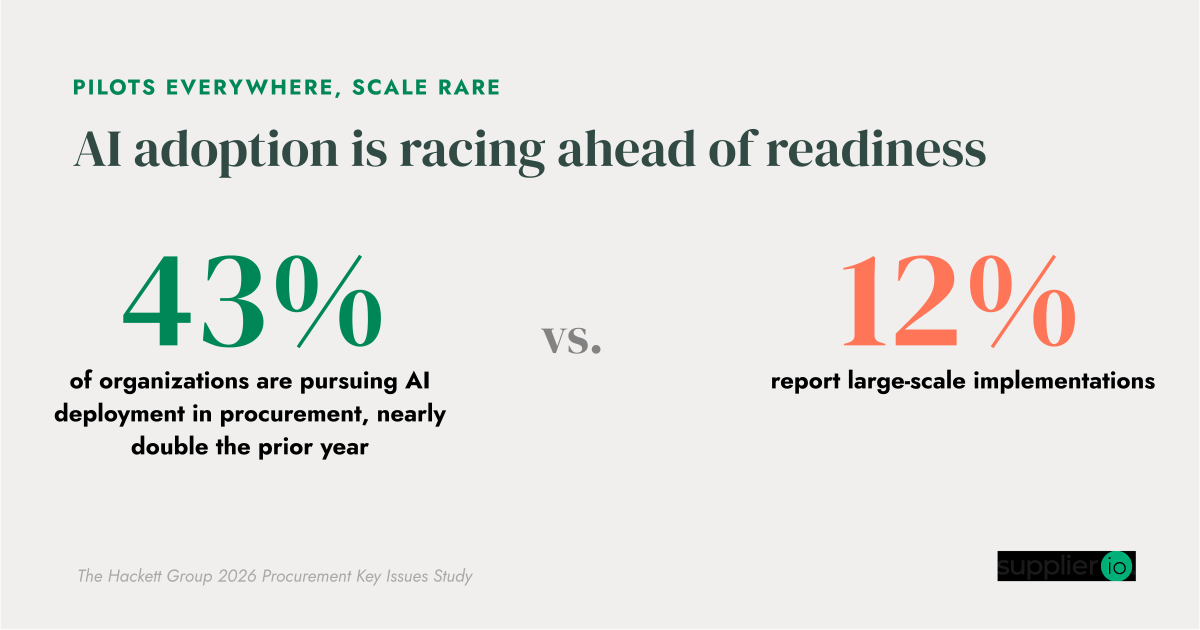
Sawchuk connected that gap to investment patterns. Procurement organizations expect roughly 12 percent of technology budgets to go to agentic AI, yet only 9 percent rate themselves very mature at data management. Hackett’s 2026 Procurement Key Issues Study puts numbers on the pattern: 43 percent of organizations are now pursuing AI deployment in procurement, nearly double the prior year, yet only 12 percent report large-scale implementations. Pilots and experiments are everywhere. The share of projects actually ready to scale remains small, and the data foundation is a primary reason why.
A second live poll suggested this session drew an unusually advanced crowd: 57 percent of respondents said they are already deploying AI with governance in place. For context, Ommen noted that in a Hackett study just two months earlier, only 1 in 5 organizations reported having a governance plan at all. Even so, the gap showed up: more than a third of respondents already deploying AI admitted their governance is still catching up.
The Opening For Procurement
Sawchuk walked through Hackett’s 2026 procurement priorities: supply continuity, spend cost reduction, deploying AI-enabled technology, transforming the operating model, and acting as a trusted advisor to the business. Supplier data does not appear on that top-10 list, but it’s what every item on the list runs on.
“How can you be trusted, if the data that you’re relying on to advise the organization isn’t trusted?” he asked. The same study names AI-enabled technology as the top transformational factor for the next five years, cited by 80 percent of respondents, while flagging deep real-time data visibility as a critical trend: rated highly important, with low organizational preparedness.
Lapierre added the insight that may matter most for deciding who acts on this. At the MIT CDOIQ Symposium, chief data officers were focused on customer, finance, and product data. Vendor data barely came up. “It’s not top of mind for the chief data officers,” she said. “That means procurement has an opportunity to take ownership of this.”
What Fixing Supplier Data Is Worth
The conversation closed on the business case. A benchmark study conducted by TealBook, now Supplier.io, with Spend Matters, now a Hackett Group company, put the true cost of managing and maintaining a supplier record at roughly $2,400 per record per year once operating costs, duplicated effort, purchased data, fraud and risk exposure, and missed sourcing opportunities are counted. The long-standing industry assumption was $500.
For an organization with $1 billion in spend and about 12,000 vendors, that works out to roughly $6 million a year in cost and lost opportunity. These are benchmark-based modeled figures rather than measured results, and Sawchuk argued they still understate the problem, because the biggest line item is the hardest to quantify:
“What’s the cost of not being able to engage quickly enough and take advantage of an opportunity that exists in the marketplace, because we don’t have the data that’s informing us to make that decision?”
Everyone landed on the same conclusion. The fix is not another cleanup project, it’s treating supplier data as an ongoing discipline with clear ownership and stewardship, supported by solutions that already exist. As Ommen put it, data quality is “not something that you do when someone brings a problem to your attention. It’s something that should be a regular practice.”
Find Out What Bad Data Is Costing You
The question the panel kept returning to was who is going to own supplier data and ensure it gets fixed?
A good first step is knowing the size of your own problem. The Supplier.io bad data calculator estimates the annual cost of bad supplier data for your organization in about two minutes. Try the calculator, then watch the full on-demand recording for the complete conversation.
Watch the Full Conversation On Demand
This recap covers the highlights, but the full session goes deeper: how the panel would establish ownership, what governance looks like in practice, and the audience questions on data readiness and interoperability. Hear it all from Stephany Lapierre, Chris Sawchuk, and Abby Ommen, on your schedule.
Watch the Webinar