Blog
The Business Case for Supplier Diversity: 6 Key Benefits
Supplier diversity is now judged on resilience, risk, and impact, not values alone. See the six benefits that make the business case and how to present them to leadership.

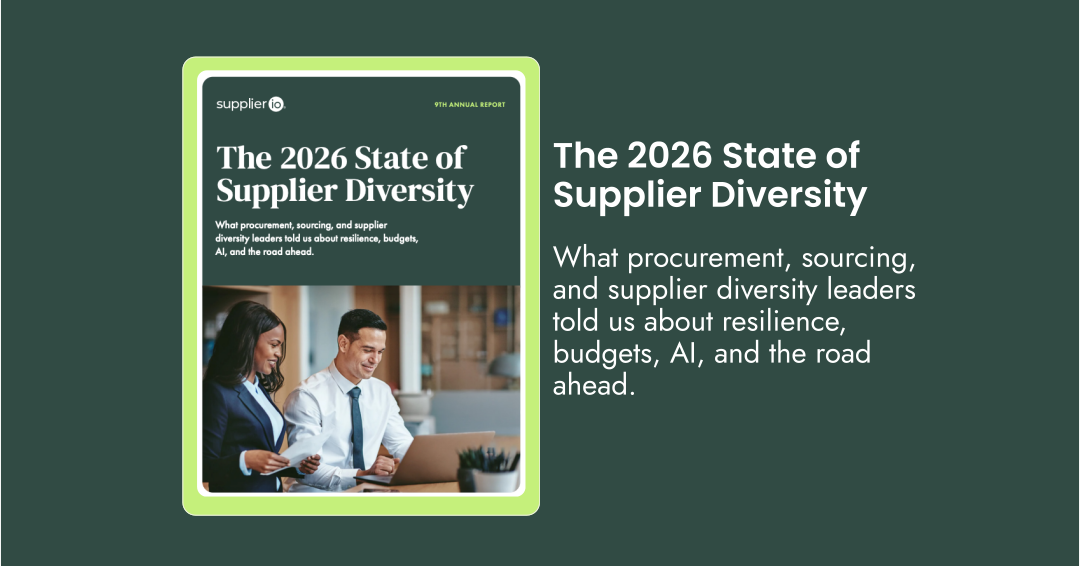
Supplier diversity is no longer judged on values alone. In the 2026 State of Supplier Diversity Report, the first time in nine reports, a business driver outranked culture as the top reason programs exist. The business case for supplier diversity now rests on resilience, risk, and measurable impact.
This guide covers what that case looks like today, six benefits to include in it, and how to present it to the leaders who fund your program.
What is the business case for supplier diversity?
The business case for supplier diversity is the argument that sourcing from a broad base of small and diverse suppliers strengthens the business, not just the community. It connects your program to outcomes executives already care about: a more resilient supply chain, lower supplier risk, new markets and ideas, and visible economic impact where you operate.
Supplier diversity benefits: six reasons it pays off
1. Supply chain resilience and competitiveness
Resilience is now the leading reason programs exist. In the 2026 report, 76% of leaders named supply chain resilience and competitiveness as a program driver, up from 65% last year. A broader supplier base gives budget owners more options when a supplier fails, a region is disrupted, or demand shifts.
Searching for a “diversified supplier base”? Diversification and supplier diversity aren’t the same thing. Diversification spreads risk across more sources. Supplier diversity adds small and certified diverse suppliers to that mix, which widens your options further and builds relationships in the communities you serve.
2. Risk mitigation in a tariff and trade environment
Trade policy is changing sourcing decisions. Fifty-four percent of leaders say tariff and trade policy changes affect how they think about their supplier base, and 65% say resilience or near-shoring is a higher priority than a year ago. Local and regional small suppliers can give you shorter, more flexible supply lines, and certified diverse suppliers add another layer of options when conditions change.
3. Competitive advantage and spend that moves the needle
The strongest programs treat small and diverse spend as a performance metric. Supplier.io benchmark data across 506 companies shows small and diverse spend averaging 7.6% of total spend, with best-in-class programs reaching 16.6%. That gap is a clear target for leaders who want to show progress, and it shows how much room most programs still have to grow.
4. Innovation and new market access
Smaller and newer suppliers often bring approaches larger incumbents don’t. They can be faster to respond, closer to local customers, and more willing to adapt to your needs. Suppliers rooted in the communities you serve also bring insight into local demand, which can inform product, marketing, and growth decisions.
5. Economic impact you can prove
Fifty-five percent of leaders name economic impact in their communities as a top program goal, but only 42% measure it. That gap is where the business case gets stronger. Programs that measure economic impact report better executive backing: 77% rate executive support at seven or higher on a 10-point scale, compared with 64% of programs that don’t measure it. This is a correlation, not proof of cause, but it points to the same conclusion. Showing the jobs, earnings, and output your spend supports gives leadership a reason to keep investing.
Want to see what your spend is generating? Try the Economic Impact Assessment Report, or read our guide to economic impact analysis.
6. Talent, culture, and brand
Culture still matters, but its role has changed. Alignment with corporate culture has fallen from a peak of 81% to 56% as a program driver. Supplier diversity can still support recruiting and brand reputation, especially for customers and employees who care how you buy. Treat these as supporting benefits behind resilience, risk, and impact, which is where leaders are focused now.
Supplier diversity in practice: a case study
When Meta asked Louisiana Economic Development for a sourcing list for a $10 billion data center, the agency had no centralized directory of local businesses to offer. With Supplier.io, it launched Source Louisiana in four to five weeks, and within a year 3,828 companies had registered, with at least one in 63 of the state’s 64 parishes. Buyers have run roughly 16,500 searches, and the general contractors on Meta’s Louisiana project now use the directory exclusively for subcontracting. Read the full customer story
Does supplier diversity still matter amid political change?
Yes, and the data shows programs are adapting rather than retreating. Fifty-three percent of leaders name political or regulatory change a top-three challenge, and 47% have renamed or rebranded their program in response. But 80% of programs have existed for three or more years, and 72% rate executive support at seven or higher. The report’s takeaway is repositioning, not retreat. Programs are leaning into the language of procurement value: resilience, risk, and impact.
How to make the business case to leadership
- Start with their priorities. Lead with resilience, risk, and cost-related outcomes before values.
- Use your own data. Pull your current small and diverse spend and compare it with the 7.6% benchmark average.
- Show the impact. Translate spend into jobs and economic output for the communities you operate in.
- Make a specific ask. Tie the case to a clear goal, budget, or tool.
For a step-by-step approach, see building a strong business case for supplier diversity investment.
Frequently asked questions
What is the business case for supplier diversity?
It’s the argument that sourcing from a broad base of small and diverse suppliers improves resilience, reduces risk, supports innovation, and creates measurable economic impact, in addition to community benefits.
What are the main benefits of supplier diversity?
The most cited today are supply chain resilience and competitiveness, risk mitigation, access to new markets and ideas, and measurable community economic impact. Culture and brand benefits remain, but they now rank behind the business drivers.
Is supplier diversity worth it for a business?
Most leaders think so. Resilience and competitiveness is the top reason programs exist (76%), and the programs that measure their economic impact report stronger executive support.
How do I measure the impact of supplier diversity?
Start with your diverse and small supplier spend, then add economic impact analysis to show the jobs, earnings, and output that spend supports in local communities.

Build your case with 2026 data
See the benchmarks, trends, and priorities behind these numbers in the 2026 State of Supplier Diversity Report.
Download now