Blog
Supplier Diversity in 2026: Mature, Leaner, and Under More Pressure
A year ago, leaders expected political change to be the biggest risk to their supplier diversity programs. It was, and the programs didn’t disappear. See the headline findings from our ninth annual report.

For nine years, Supplier.io has asked the people who run supplier diversity programs, “Why does your program exist?” “Who supports it?” “What do you measure?” “What’s getting in your way?”
This year, 194 procurement, sourcing, and supplier diversity leaders answered. Their responses describe a discipline that spent the last 12 months absorbing new executive orders, tariff shocks, and a wave of AI tools, and came out of it restructured more often than diminished.
That isn’t where the headlines said supplier diversity would be in 2026. Here’s what the data shows, and what it means for the year ahead.
Three numbers that frame the year
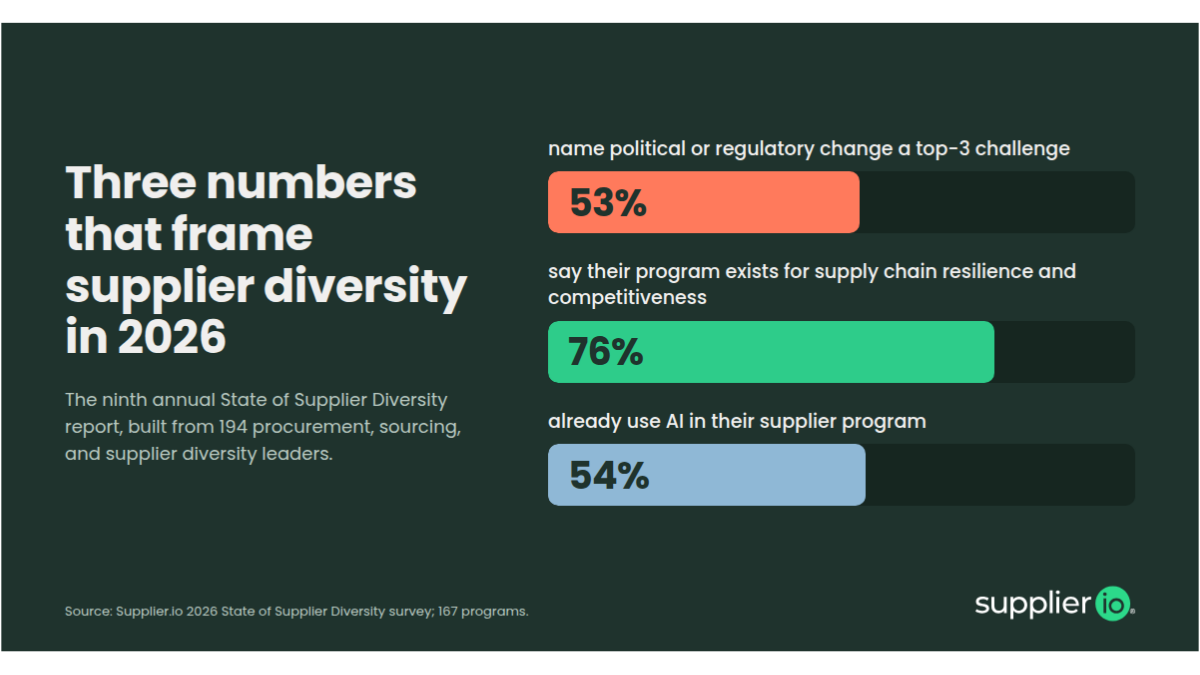
53% of leaders name political or regulatory change a top-three challenge. Two years ago, 90% said politics wasn’t affecting their program at all. This year, nearly half have renamed or rebranded, and 63% report new compliance concerns tied to executive orders.
76% say their program exists for supply chain resilience and competitiveness. That puts a business driver ahead of alignment with corporate culture for the first time in nine reports. The shift didn’t happen this year, but this is the year it became visible.
54% already use AI in their supplier program, in the first year the survey asked. Most apply it to supplier discovery and sourcing. Fewer than half of all respondents, though, are confident in the supplier data underneath it.
Repositioning, not retreat
A year ago, leaders expected political change to be the biggest risk to their programs in 2026. It was, and the programs didn’t disappear.
Programs are established: 80% have existed for three or more years, and only 8% are less than a year old. Executive support held: 72% of leaders rate it at seven or higher on a 10-point scale, consistent with last year, when 87% said support was the same or greater than the year before.
What changed is how programs describe themselves and who they talk to. Half scaled back public-facing communications. Four in 10 shifted their framing toward procurement and business value. Only 18% reported no change at all.
The energy went inside. Increasing internal visibility and executive engagement was the single most common program change this year and the most common plan for next year. Programs are talking more to the people who fund them and less to the public, which is a deliberate choice, and the data suggests it will hold for another year.
The business case has overtaken the values case
Asked why their program exists, leaders put resilience and competitiveness first, at 76%, ahead of culture alignment at 56%. Last year, culture led by two points. This year, competitiveness leads by twenty.
Asked to pick a single category that best describes their program’s value to the business, leaders split almost evenly across procurement intelligence, compliance and risk management, and community and economic impact. DEI and culture, once the default answer, is now last at 9%.
The full report tracks the ‘why does your program exist’ question back to 2017, which is the clearest long-run trend in the series. It’s also the clearest explanation for why “supplier diversity” is now only one of several labels leaders use for the same work.
The gap between wanting to prove impact and measuring it
Here’s the finding that should matter most to anyone building a budget request.
Fifty-five percent of leaders say economic impact in their communities is a reason their program exists, but only 42% measure it. Eighty-nine percent track spend, which is the one metric nearly every supplier diversity program has.
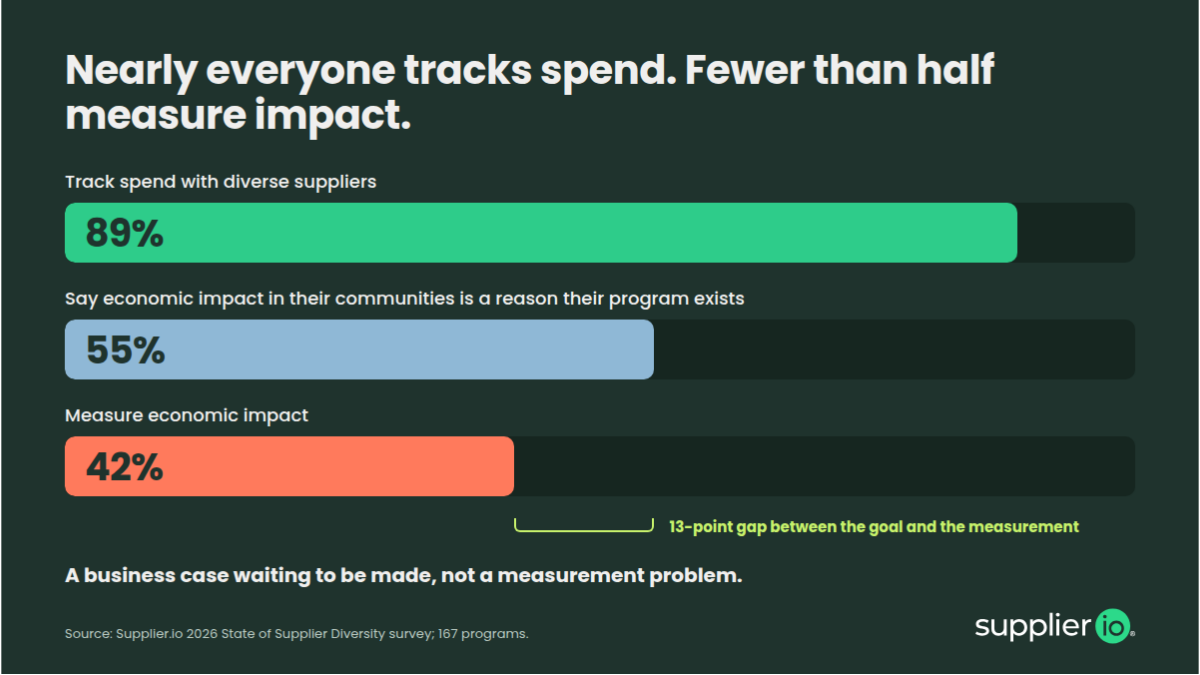
That gap has existed for almost a decade. It’s closing, but slowly. The programs that have closed it tend to report the strongest executive support: 77% of programs that measure economic impact rate it seven or higher, versus 64% of those that don’t. The report’s read is that this is a business case waiting to be made rather than a measurement problem, and the report calls it the highest-return measurement investment a program can make.
AI is a data question first
More than half of programs already use AI, mostly for supplier discovery and data enrichment. At the same time, 57% of leaders say their underlying supplier data is incomplete, and among programs using AI, only 42% are confident in that data.
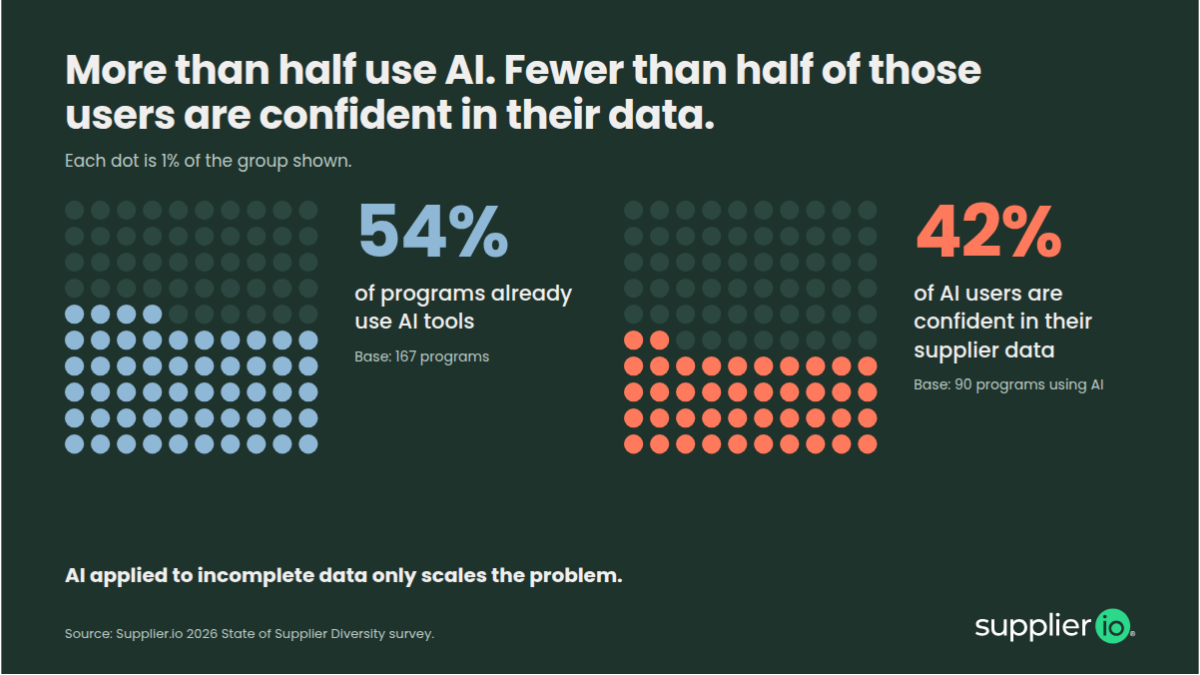
AI applied to incomplete data scales the problem. The report’s advice is to treat data quality as the first AI project rather than a parallel one: one trusted record per supplier, verified certifications, and a regular refresh cadence.
What the full report adds
While this covers the headlines, the 2026 State of Supplier Diversity report adds the evidence behind them, including:
- Nine years of data on why programs exist, year by year, and the moment the business case overtook the values case
- A cross-check of the survey against $3.4 trillion in 2025 spend across 506 companies, where survey intent and spend behavior agree, and where the gap itself is the finding
- What programs actually changed in response to the political climate: renaming, restructuring, budget, and messaging, with the numbers behind each
- Five actions for program leaders, built from the survey findings
Hear the full story live
Join Supplier.io founder and CEO Neeraj Shah and Sr. Customer Success Manager Elisa Ryan on November 3 at 2:00 pm ET for a walkthrough of what leaders did this year, how your program compares, and five priorities for 2027.
Register nowSupplier diversity in 2026 is more mature, leaner, and more business-focused than the headlines suggested. The takeaway for 2027: stop waiting for a return to normal and start planning for continued pressure.